ADMIRE Moths
Advancing Monitoring and Image Recognition of European Moths (2026 - 2028)
Overview
Moths are a vital part of terrestrial ecosystems across Europe and are the most diverse group of pollinators in Europe. They play an important role as pollinators of wildflowers and are important prey to birds, bats and other insectivorous animals.
ADMIRE Moths is a major EU funded project to expand the monitoring of moths in Europe, which is now a requirement for all Member States under the Nature Restoration Regulation. The project runs from October 2026 to October 2028 and is led by Dutch Butterfly Conservation, together with Butterfly Conservation Europe and 5 other partners across Europe.
The project will:
- Produce an image library of night active macro-moth species from across Europe, filling gaps in existing databases used by AI-based image recognition systems, through extensive fieldwork.
- Run training and networking programmes to develop the taxonomic and para-taxonomic capacity to identify European moths, focussing on regions and taxonomic groups where expertise is currently limited.
- Produce training materials suitable for identifying specimens in the field and in the laboratory, including a national species list for each EU Member State and identification keys for genera and species.
- Produce specifications and guidance for light traps, including a technical specification for light trap design and operation; and an illustrated field guide for surveyors including image collection protocols.
Many of the outputs, such as the full list of species in scope, will be made publicly available in this section as the project progresses.
About the Project
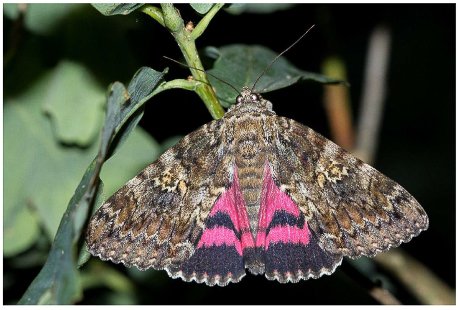
Dark Crimson Underwing Catocala sponsa. The genus Catocala comprises 25 species, many of which are superficially similar
ADMIRE Moths is an EU funded project to support moth monitoring under the Nature Restoration Regulation (NRR). The project started in October 2026 and will be completed by October 2028.
The project partners are Dutch Butterfly Conservation (De Vlinderstichting (DVS) as project coordinator), the UK Centre for Ecology and Hydrology (UKCEH), Butterfly Conservation Europe (BCE), Lund University, Sweden (LU), Aarhus University, Denmark (AU), Rede de Estações de Borboletas Noturnas (REBN) (the Portuguese Moth Recording Scheme) (PMMN) and Helder Cardoso from Portugal.
In addition, the project has recruited more than 20 collaborators from various countries and institutions, including museums, Lepidoptera societies and associations, and universities. These experts will contribute their experience in moth biology, taxonomy, and monitoring.
If you want to participate in the project or you want further information about the project, please contact the project team.
Background
The Nature Restoration Regulation (NRR) 2024 requires EU Member States to improve pollinator diversity and reverse the decline of pollinator populations by 2030. It also requires Member States to monitor pollinator abundance and diversity using the science-based method established by the EU Pollinator Monitoring Scheme (EU-PoMS) as described in a Delegated Regulation adopted in 2025. The 4 taxonomic groups of pollinators that must be monitored on an annual basis are bees (2048 species), butterflies (431 species), hoverflies (892 species) and moths (approximately 2800 species of larger moths). Pollinator monitoring must start in December 2026, though in practice it will start in the Spring of 2027 when the insect flight period starts.
ADMIRE Moths is the first EU funded project to support Member States implementing moth monitoring under the NRR.
The scope of the project
The taxonomic scope of the ADMIRE Moths project covers 16 families of night-active species of moths (Heterocera). This includes species not listed in Article 1(4) of the Delegated Regulation, because the image recognition should be trained to differentiate species that are covered by the Delegated Regulation from those that are not. Within this project we will make a list for each Member State that includes species with a wingspan of below 20 mm that are excluded from the Delegated Regulation.
The geographical scope is the European territory of Member States, including the Canary Islands, Azores and Madeira.
There are about 11,000 species of moths in Europe and between 2,000 and 3,000 species will be in the scope of this project. Many project outputs, such as the full list of species in scope, will be made publicly available – see "Project Outputs" below.
The project is divided into 7 tasks.
Task 1: Gap analysis of AI-based image recognition tools
Task 1, led by UKCEH, will produce a complete list of the moth species that are in scope, then assess the performance of existing AI-based image recognition tools to identify those species. The outcome will be a list of target species for improving AI-based image classifiers.
The existing AI-based tools are generally good at identifying the species found in northern and western Europe where typically there are many citizen scientists who carry out moth trapping, send their records into a national moth recording scheme and have provided the photographs used to train the AI-based tools. However, in southern and eastern Europe, the AI-based tools are generally poor at identifying moth species because there is very little moth trapping, recording and photographing being carried out. It is also anticipated that species endemic to EU island groups (e.g. the Canary Islands, Azores, or Mediterranean islands) will be relatively underrepresented in the datasets used for training the existing image recognition algorithms, leading to lower performance in AI models.
Task 1 will be completed within 3 months of the start of the project, which means by the end of 2026.
Task 2: Creating an image library to fill the identified gaps
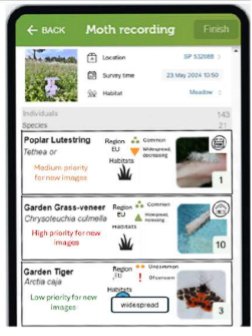
Mock-up of the moth recording module within ButterflyCount to highlight priority moth species for image collection
Task 2, led by DVS, will involve trapping and photographing moths to produce a library of images that will be used to train the AI-based image recognition models. A review of the existing AI classifiers will also be carried out.
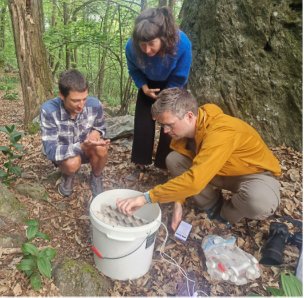
The project will carry out at least 500 site visits, setting moth traps and organising fieldwork sessions.
The priority sites will be determined by the gap analysis in Task 1. They are most likely to be in Portugal, Spain, Italy, Malta, Croatia, Slovenia, Greece, Cyprus, Bulgaria, Hungary, Slovakia, Romania, Czechia and Poland.
Data from moth trapping sessions in the field will be collated via the moth survey functionality in the ButterflyCount mobile application. This App is part of the European Butterfly Monitoring Schemes (eBMS) infrastructure that supports recording and monitoring of butterflies and moths. A few minor modifications to the App will add specific functionality required by the project. The App provides a readily available, tried-and-tested, efficient approach to meet the project deliverables.
Field work will be carried out in 2027 and 2028, with the aim of collecting at least 20,000 images of at least 800 species of moths covered by the Delegated Regulation.
Task 3, Uploading of moth images to online identification platforms
Task 3, led by UKCEH, will upload the images collected in Task 2 to available identification platforms. This will enhance the ability of the algorithms to identify moths to the species level.
Task 4: Developing and implementing a training and networking programme for taxonomy and para-taxonomy of moths
Task 4, led by BCE, will support the implementation of EU-PoMS by building capacity in moth identification, field survey methods, specimen handling and validation workflows, with particular attention to regions and taxonomic groups where expertise is currently limited.
The Commission currently supports the European Pollinator Identification Courses (EPIC) project which is developing para-taxonomic capacity for implementing the EUPoMS. These courses cover wild bees (EPIC-bee), hoverflies (EPIC-fly) and butterflies (EPIC-butterfly), but not moths. The ADMIRE Moths project will complement the EPIC project by providing capacity building activities for moths, concentrating on building taxonomic expertise for determining difficult-to-identify specimens in the laboratory.
The training program will be structured at three levels to reflect the prior experience of participants and increasing complexity of moth identification:
- Level 1 - basic: common and widespread species
- Level 2 - intermediate: less widespread species
- Level 3 - advanced: species that are difficult to identify including dissection
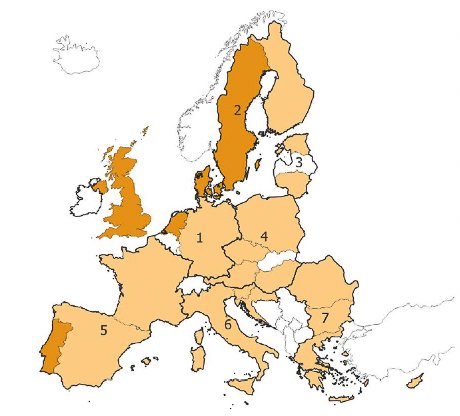
Map showing the countries that are part of the ADMIRE Moth project, divided into partners (dark orange) and collaborators (light orange)
The seven proposed regional groups for the training courses are defined by bold borders:
- Region 1. North/Central: Netherlands, Belgium, Ireland, Luxembourg, Germany
- Region 2. Scandinavia: Sweden, Finland, Denmark
- Region 3. Baltic: Lithuania, Latvia, Estonia
- Region 4. Central/Eastern: Czechia, Austria, Poland, Slovakia, Hungary
- Region 5. Atlantic/Mediterranean: France, Portugal (including the Azores and Madeira), Spain (including the Canary Islands)
- Region 6. South/Central: Italy, Croatia, Slovenia, Malta
- Region 7. Eastern/Mediterranean: Romania, Bulgaria, Greece, Cyprus
The countries shown in bold will most probably lead the delivery of the training courses.
The ADMIRE Moths project provides an important opportunity to strengthen networking capacity for moth monitoring and taxonomy across Europe. The project will build on BCE’s existing experience in coordinating international butterfly expert networks and scientific meetings to support the development of a sustainable European community of practice for moth monitoring.
Task 5: Provision of specific training materials suitable for identifying specimens in the field and in the laboratory
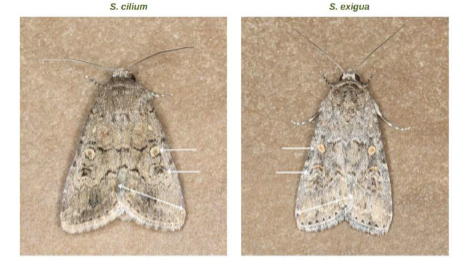
Example of the species-specific diagnostic characteristics
Task 5, led by REBN, will provide:
- the national species lists for each Member State (or regions)
- identification keys for genera and species
The training materials will be produced electronically and in English, though they may be translated into other languages if there is sufficient demand and if the project has the resources to do so.
Task 6: Development of technical specifications and guidance for light traps
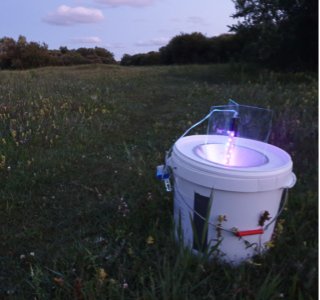
Task 6, led by LU, will develop two complementary practical outputs that support harmonised and scientifically robust moth monitoring under EU-PoMS:
- a technical specification for light trap design and operation; and
- an illustrated field guide for surveyors and image collection protocols.
Together, these outputs will support standardisation of monitoring approaches across Member States and improve the quality, comparability, and AI-readiness of moth monitoring data collected under the project.
Task 7: Communication
Task 7, led by DVS, will ensure effective communication, dissemination, visibility, and stakeholder engagement throughout the ADMIRE Moths project. The task will support transparency, facilitate uptake of project outputs by Member States and stakeholders, and strengthen long-term accessibility of project results and training materials.
In task 7, the ADMIRE Moths project will deliver:
- A description of the project for publication on European Commission websites
- Publications and online dissemination materials compliant with Commission communication requirements
- Online access to training materials, course information, and project output
- Webinars to Member State authorities, academia, NGOs etc.
- Presentations to Commission expert groups and policy networks
- Project meetings and coordination with the Commission
Project outputs
Many of the outputs, such as the full list of species in scope, will be made publicly available here. This section will be updated as the project progresses.
[November 2026 – the project has just started so no outputs are yet available]
The project is funded by a service contract from the European Union DG Environment (EC-ENV/2026/NP/0011): SUPPORTING MOTH MONITORING UNDER THE NATURE RESTORATION REGULATION.