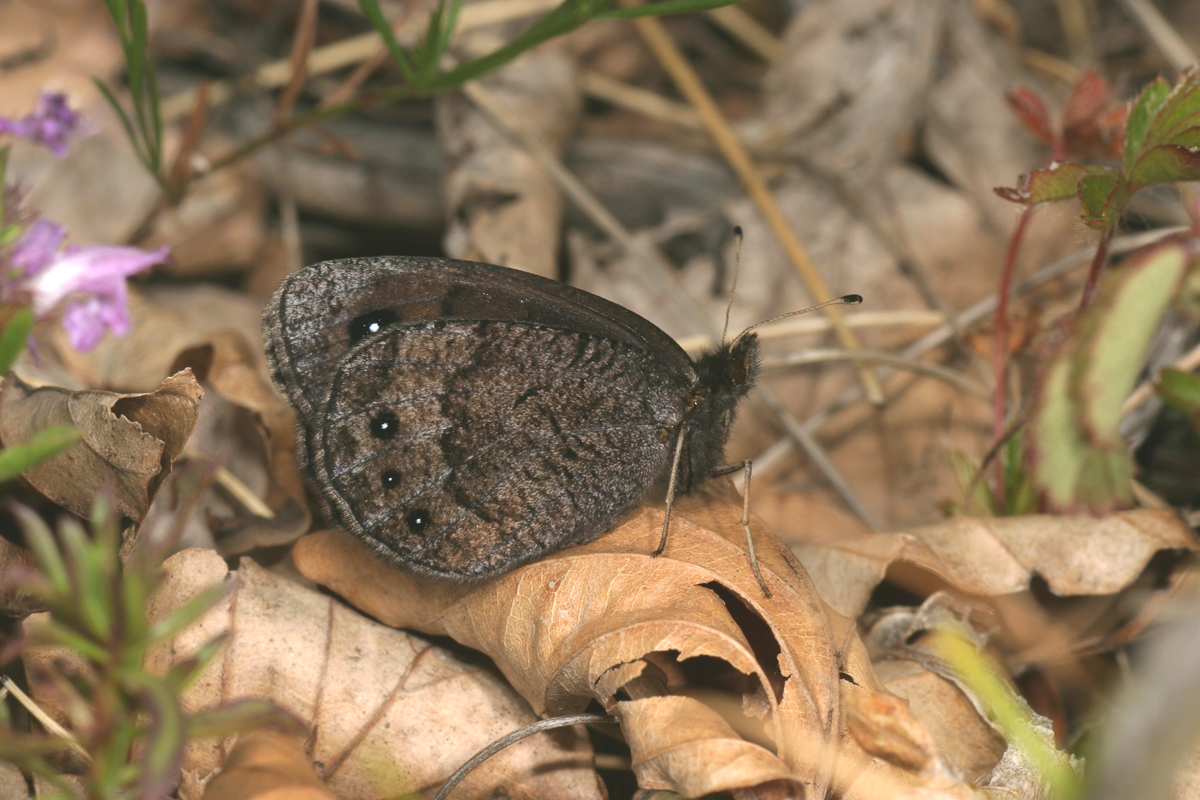
Black Ringlet (Erebia melas)
| Family | Nymphalidae |
|---|
| Subfamily | Satyrinae |
|---|
| Genus | Erebia |
|---|
| Species | melas |
|---|
| Authority | (Herbst, 1796) |
|---|
| English Name | Black Ringlet |
|---|
| European Red List 2010 | Least Concern (LC) |
|---|
| EU 27 Red List 2010 | Least Concern (LC) |
|---|
| European Red List 2025 | Near Threatened (NT) |
|---|
| EU 27 Red List 2025 | Near Threatened (NT) |
|---|
| Habitats Directive | |
|---|
| Bern Convention | |
|---|
| CITES | |
|---|
Description
The Black Ringlet can be found on rocky slopes with patches of grassy vegetation, in dry and sub-
alpine and alpine grasslands, and sometimes in clearings in coniferous woods. The butterflies fly
close to the ground, often resting with wings widespread. The caterpillars feed on Sheeps’-fescue
(Festuca ovina), and possibly other grasses. The Black Ringlet has one generation a year and hibernates
in the larval stage.
Distribution
Albania / Bosnia and Herzegovina / Bulgaria / Croatia / Greece / Greece: Mainland / North Macedonia / Montenegro / Romania / Serbia / Serbia: Serbia / Serbia: Kosovo / Slovenia /
Larval Foodplants
No larval foodplants are available for this species.