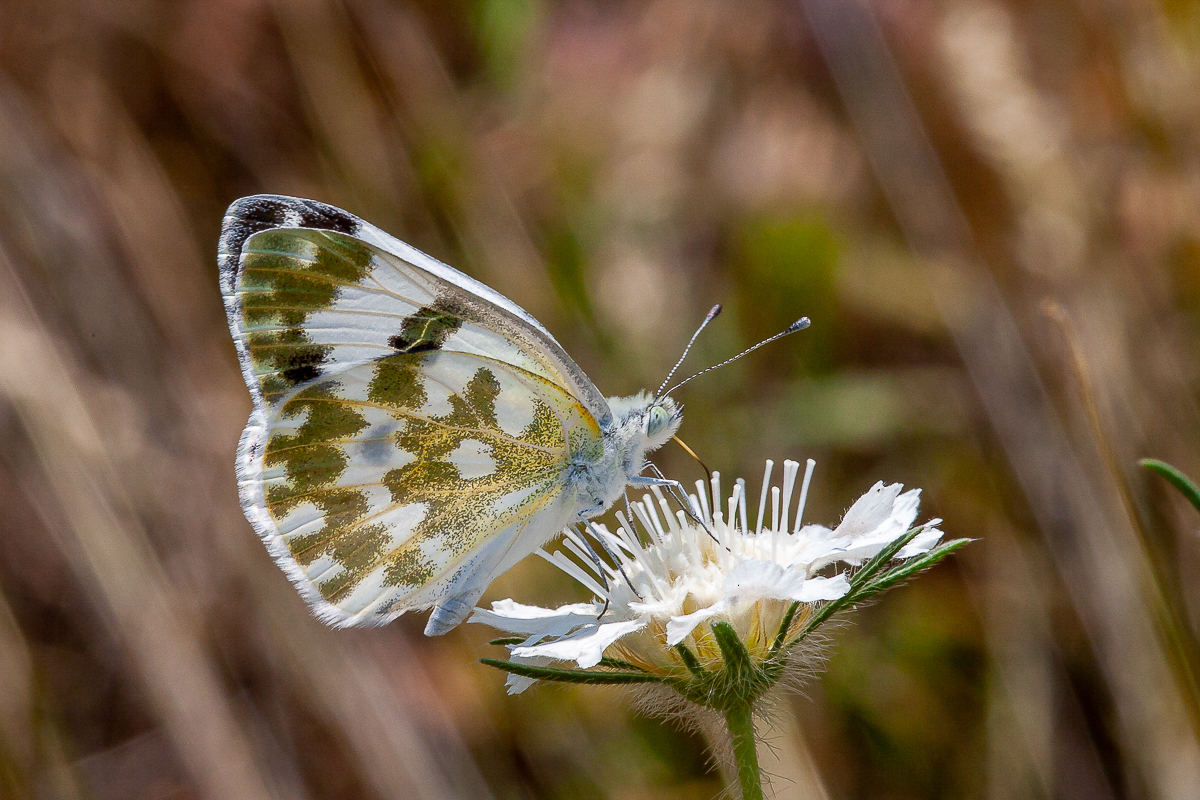
Eastern Bath White (Pontia edusa)
| Family | Pieridae |
|---|
| Subfamily | Pierinae |
|---|
| Genus | Pontia |
|---|
| Species | edusa |
|---|
| Authority | (Fabricius, 1777) |
|---|
| English Name | Eastern Bath White |
|---|
| European Red List 2010 | Least Concern (LC) |
|---|
| EU 27 Red List 2010 | Least Concern (LC) |
|---|
| European Red List 2025 | Least Concern (LC) |
|---|
| EU 27 Red List 2025 | Least Concern (LC) |
|---|
| Habitats Directive | |
|---|
| Bern Convention | |
|---|
| CITES | |
|---|
Description
The Bath White complex has been split into two species in the 1980s, P. daplidice (LINNAEUS, 1758), which
mainly occurs in the Western Mediterranean, and P. edusa (FABRICIUS, 1777), which is distributed over the rest
of Europe. However, these two species cannot be distinguished in the field. Their life cycles are also very
similar. The adult butterflies are very mobile, fast flying and migrate northwards and westwards in warm
years. They occur in warm, stony places; often disturbed ground, such as road verges, abandoned agricultural land or quarries. The females lay their eggs on such crucifers as mustards (Sinapis spp.), Alyssum spp.,
and also on mignonettes (Reseda spp.). The caterpillars feed mainly on the flowers and seeds. Pupation takes
place on the stalk of the foodplant. These species have two or more broods a year and hibernate as pupae.
Distribution
Albania / Austria / Belarus / Belgium (Irregular Vagrant) / Belgium: Flanders (Regionally Extinct) / Belgium: Wallonia (Irregular Vagrant) / Bosnia and Herzegovina / Bulgaria / Croatia / Czechia / Denmark (Regular Migrant) / Estonia (Irregular Vagrant) / Finland (Regular Migrant) / France: Corsica (Possibly Present) / Germany / Greece / Greece: Mainland / Greece: East Aegean Islands / Greece: Kirti (Crete) / Hungary / Italy / Italy: Mainland / Italy: Sicily / Latvia / Lithuania / Luxembourg (Irregular Vagrant) / North Macedonia / Malta (Possibly Present) / Moldova / Montenegro / Netherlands (Irregular Vagrant) / Norway (Irregular Vagrant) / Poland / Romania / European Russia / San Marino / Serbia / Serbia: Serbia / Serbia: Kosovo / Slovakia / Slovenia / Sweden / Switzerland / European Türkiye / Ukraine /
Larval Foodplants
| # | Order | Family | Genus | Species | Vernacular Name | Link | | 1 | Brassicales | Brassicaceae | Berteroa | incana | Hoary Alison | |
| 2 | Brassicales | Brassicaceae | Brassica | napus | Oil-seed Rape (see ssp.) | |
| 3 | Brassicales | Brassicaceae | Diplotaxis | tenuifolia | Perennial Wall-rocket | |
| 4 | Brassicales | Brassicaceae | Erysimum | cheiranthoides | Treacle-mustard | |
| 5 | Brassicales | Brassicaceae | Lepidium | campestre | Field Pepperwort | |
| 6 | Brassicales | Brassicaceae | Lepidium | ruderale | Narrow-leaved Pepperwort | |
| 7 | Brassicales | Brassicaceae | Teesdalia | nudicaulis | Shepherd's Cress | |
| 8 | Brassicales | Resedaceae | Reseda | alba | White Mignonette | |
| 9 | Brassicales | Resedaceae | Reseda | lutea | Wild Mignonette | |
| 10 | Brassicales | Resedaceae | Reseda | luteola | Weld | |