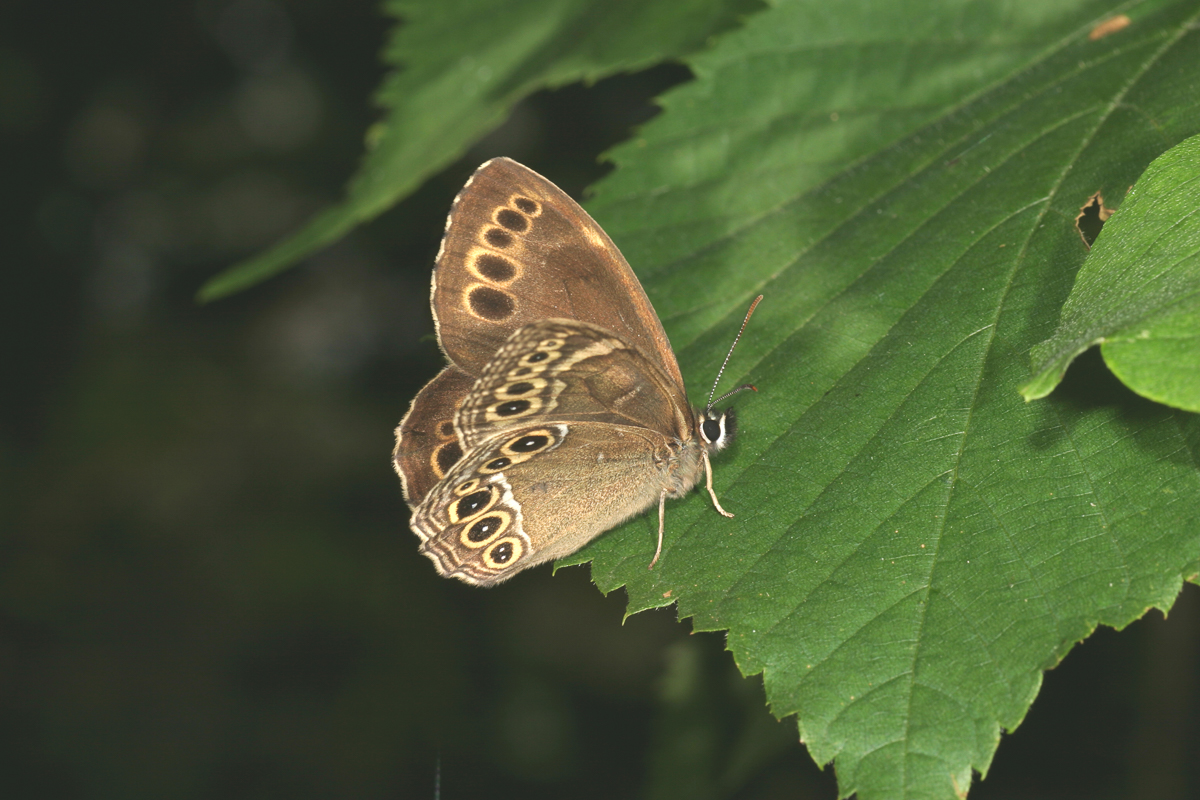
Woodland Brown (Lopinga achine)
| Family | Nymphalidae |
|---|
| Subfamily | Satyrinae |
|---|
| Genus | Lopinga |
|---|
| Species | achine |
|---|
| Authority | (Scopoli, 1763) |
|---|
| English Name | Woodland Brown |
|---|
| European Red List 2010 | Vulnerable (VU) |
|---|
| EU 27 Red List 2010 | Vulnerable (VU) |
|---|
| European Red List 2025 | Near Threatened (NT) |
|---|
| EU 27 Red List 2025 | Near Threatened (NT) |
|---|
| Habitats Directive | HD IV |
|---|
| Bern Convention | BC II |
|---|
| CITES | |
|---|
Description
The Woodland Brown is fond of warm, open places in damp, deciduous or mixed woods with well-
developed shrub and herbaceous layers. The butterflies rarely visit flowers, preferring to feed on
honeydew, moisture on buds, and sap oozing from wounded trees. The males often settle on puddles
on the ground, while the females tend to stay in the very top of the trees. Eggs are laid on all sorts of
grasses, including fescues (Festuca spp.), meadow-grasses (Poa spp.), small-reeds (Calamagrostis spp.),
and false-bromes (Brachypodium spp.), and also on sedges (Carex spp.). The half-grown caterpillar
hibernates in a grass tussock, where later in the year it also pupates. The Woodland Brown has one
brood a year.
Distribution
Austria / Belarus / Belgium (Regionally Extinct) / Belgium: Wallonia (Regionally Extinct) / Bosnia and Herzegovina (Regionally Extinct) / Bulgaria / Croatia / Czechia / Estonia / Finland / France / France: Mainland / Germany / Hungary / Italy / Italy: Mainland / Latvia / Lithuania / Luxembourg (Regionally Extinct) / Moldova (Possibly Present) / Netherlands (Irregular Vagrant) / Poland / Romania / European Russia / Serbia (Regionally Extinct) / Serbia: Serbia (Regionally Extinct) / Slovakia / Slovenia / Spain / Spain: Mainland / Sweden / Switzerland / Ukraine /
Larval Foodplants
| # | Order | Family | Genus | Species | Vernacular Name | Link | | 1 | Poales | Cyperaceae | Carex | | Sedges | |
| 2 | Poales | Cyperaceae | Carex | alba | | |
| 3 | Poales | Cyperaceae | Carex | brizoides | | |
| 4 | Poales | Cyperaceae | Carex | fritschii | | |
| 5 | Poales | Cyperaceae | Carex | michelii | | |
| 6 | Poales | Cyperaceae | Carex | montana | Soft-leaved Sedge | |
| 7 | Poales | Juncaceae | Luzula | pilosa | Hairy Wood-rush | |
| 8 | Poales | Poaceae | Avenella | flexuosa | Wavy Hair-grass | |
| 9 | Poales | Poaceae | Brachypodium | pinnatum | Heath False-brome | |
| 10 | Poales | Poaceae | Brachypodium | sylvaticum | False-brome | |
| 11 | Poales | Poaceae | Deschampsia | cespitosa | Tufted Hair-grass | |
| 12 | Poales | Poaceae | Festuca | rubra | Red Fescue | |
| 13 | Poales | Poaceae | Poa | pratensis | Smooth Meadow-grass | |