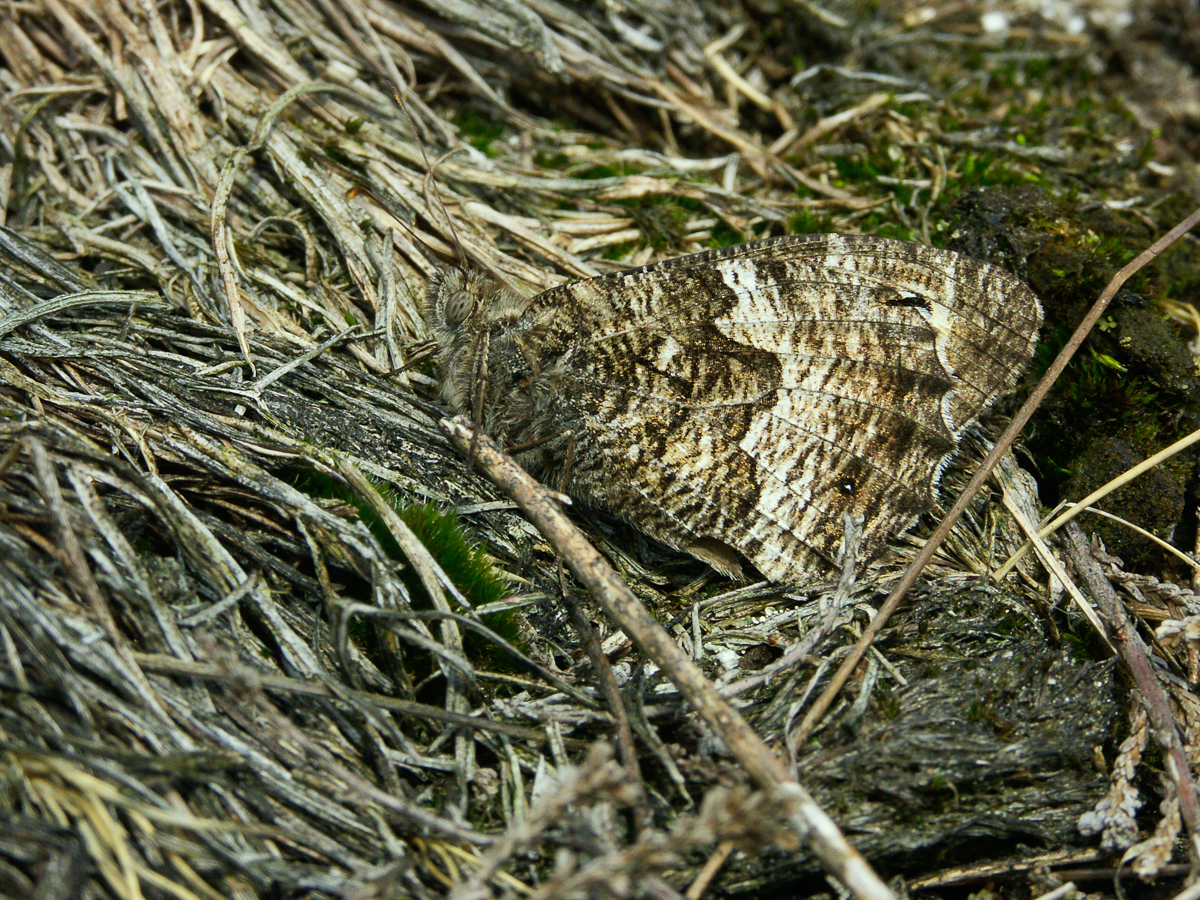
Grayling (Hipparchia semele)
| Family | Nymphalidae |
|---|
| Subfamily | Satyrinae |
|---|
| Genus | Hipparchia |
|---|
| Species | semele |
|---|
| Authority | (Linnaeus, 1758) |
|---|
| English Name | Grayling |
|---|
| European Red List 2010 | Least Concern (LC) |
|---|
| EU 27 Red List 2010 | Least Concern (LC) |
|---|
| European Red List 2025 | Least Concern (LC) |
|---|
| EU 27 Red List 2025 | Least Concern (LC) |
|---|
| Habitats Directive | |
|---|
| Bern Convention | |
|---|
| CITES | |
|---|
Description
The Grayling is found in dry, infertile surroundings, occurring on poor, dry grasslands, dry heaths,
and also often at the coast. The males and females meet each other above a solitary tree in a wide
open landscape, such as a pine on heathland. The female lays her eggs on various fine-leaved grasses,
including fescues (Festuca spp.), bents (Agrostis spp.), and bromes (Bromus spp.). Walking over the
bare ground, she approaches a grass tussock, and deposits an egg on a withered grass blade a
few centimetres above the ground. The caterpillar grows very slowly, feeding mostly at night. It
hibernates deep down in a grass tussock. When it is ready to pupate, it spins itself a sort of cocoon
in a little hollow in the ground. The Grayling has one brood a year.
Distribution
Albania / Andorra / Austria / Belarus / Belgium / Belgium: Flanders / Belgium: Wallonia / Bosnia and Herzegovina / Bulgaria / Croatia / Czechia / Denmark / Estonia / Finland / France / France: Mainland / Germany / Hungary / Ireland / Italy / Italy: Mainland / Italy: Sicily / Latvia / Liechtenstein / Lithuania / Luxembourg / Netherlands / Norway / Poland / Portugal / Portugal: Mainland / Romania / European Russia / Serbia / Serbia: Serbia / Serbia: Kosovo (Possibly Present) / Slovakia / Slovenia / Spain / Spain: Mainland / Spain: Balearic Islands / Sweden / Switzerland / Ukraine / United Kingdom / United Kingdom: Great Britain / United Kingdom: Northern Ireland / United Kingdom: Isle of Man / United Kingdom: Guernsey / United Kingdom: Jersey /
Larval Foodplants
| # | Order | Family | Genus | Species | Vernacular Name | Link | | 1 | Poales | Poaceae | Achnatherum | parviflorum | | |
| 2 | Poales | Poaceae | Agrostis | capillaris | Common Bent | |
| 3 | Poales | Poaceae | Aira | caryophyllea | Silver Hair-grass | |
| 4 | Poales | Poaceae | Aira | praecox | Early Hair-grass | |
| 5 | Poales | Poaceae | Alpagrostis | setacea | | |
| 6 | Poales | Poaceae | Arrhenatherum | elatius | False Oat-grass | |
| 7 | Poales | Poaceae | Avenella | flexuosa | Wavy Hair-grass | |
| 8 | Poales | Poaceae | Brachypodium | phoenicoides | | |
| 9 | Poales | Poaceae | Brachypodium | pinnatum | Heath False-brome | |
| 10 | Poales | Poaceae | Brachypodium | retusum | | |
| 11 | Poales | Poaceae | Briza | media | Quaking-grass | |
| 12 | Poales | Poaceae | Bromus | erectus | | |
| 13 | Poales | Poaceae | Calamagrostis | arenaria | | |
| 14 | Poales | Poaceae | Corynephorus | canescens | Grey Hair-grass | |
| 15 | Poales | Poaceae | Deschampsia | cespitosa | Tufted Hair-grass | |
| 16 | Poales | Poaceae | Deschampsia | cespitosa ssp. cespitosa | | |
| 17 | Poales | Poaceae | Elymus | repens | Common Couch | |
| 18 | Poales | Poaceae | Festuca | | Fescues | |
| 19 | Poales | Poaceae | Festuca | elegans | | |
| 20 | Poales | Poaceae | Festuca | guestfalica | | |
| 21 | Poales | Poaceae | Festuca | guestfalica ssp. guestfalica | | |
| 22 | Poales | Poaceae | Festuca | ovina | Sheep's-fescue | |
| 23 | Poales | Poaceae | Festuca | rubra | Red Fescue | |
| 24 | Poales | Poaceae | Festuca | trachyphylla | Hard Fescue | |
| 25 | Poales | Poaceae | Festuca | valesiaca | | |
| 26 | Poales | Poaceae | Koeleria | pyramidata | | |
| 27 | Poales | Poaceae | Lolium | perenne | Perennial Rye-grass | |
| 28 | Poales | Poaceae | Phleum | phleoides | Purple-stem Cat's-tail | |
| 29 | Poales | Poaceae | Sesleria | albicans | | |
| 30 | Poales | Poaceae | Stipa | | | |
| 31 | Poales | Poaceae | Stipa | lagascae | | |
| 32 | Poales | Poaceae | Stipa | offneri | | |
| 33 | Poales | Poaceae | Stipa | pennata | | |